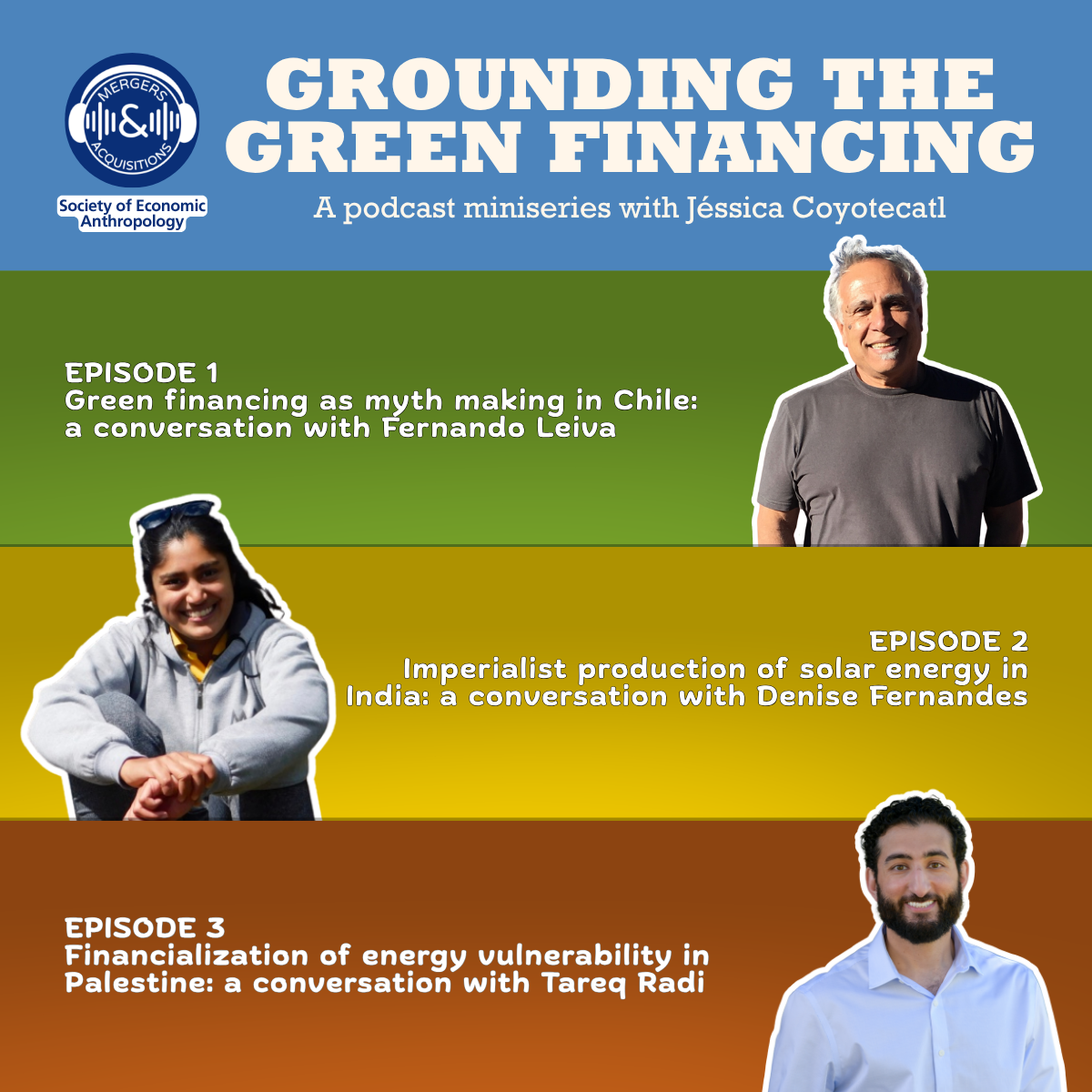

Grounding the Green Finance: A podcast miniseries
Listen to these conversations!
This series brings together scholars researching the relationship between green finance and the everyday experiences of violence and solidarity across the world. Green finance, the various models of loans and investments that ostensibly support mitigation and adaptation to climate change, is promoted by international bodies such as the United Nations and the World Bank. However, the abstraction of this language and policies involved obscures the connections to everyday practices of extraction and resistance. This series reinfuses the economics of climate change with people’s histories and agencies. Therefore, anthropologists and adjacent field scholars are particularly well suited to ground the climate finance discussion in place-based, community-informed explorations across the globe.
Find out more about the Mergers and Acquisitions Podcast, by the Society for Economic Anthropology in collaboration with the American Anthropological Association.
Green financing as myth making in Chile: a conversation with Fernando Leiva
Fernando Leiva talks about his mapping of the finance-extractivism-climate-change-energy transition nexus focused on Chile, his country of origin. In his view, green finance is also a hegemonic myth project that presents the private sector as the social actor of the future, in an unequal field of cultural creation, against communities betting on collective forms of life. Leiva argues that critical scholarship is needed in these cultural battles of meaning making for the future.
Imperialist production of solar energy in India: a conversation with Denise Fernandes
Denise Fernandes recounts the global process that solidified a top-down and market-driven approach to climate change action. In her analysis of the Rewa Solar Park in India, Denise weaves together the long history of colonialism, the flow of capital, and science and technologies that produce the “free, clean, and green energy.” As a result of these processes, certain spaces, like the Gurh tehsil, become banjaar zameen (barren lands) amenable to megaprojects backed by green loans from the World Bank, in what Denise describes as American energy imperialism.
Financialization of energy vulnerability in Palestine: a conversation with Tareq Radi
Tareq Radi outlines the struggle for the future through the financialization of Palestinian electricity sector that links capitalist speculation and disciplining. He analyzes the Palestine Real Estate and Investment Company’s (PRICO) solar project in Gaza, promoted by the World Bank, using a critical reading of finance reports against historical and current fights for freedom across Palestine. Tareq relates the connections between cyclical waves of colonial interventions to financial instruments and data gathering in times of extreme violence.